Before you argue about whether your marketing is working, check whether your analytics can even see it. Every dashboard, vendor scorecard, and "conversions are up 12 percent" email sits on top of one thing: how GA4 is configured. If the events underneath are missing, misfiring, or never promoted, the number on top is confident-looking garbage. It renders in a clean chart. It just isn't true.
Why configuration precedes truth
GA4 does not report on what happened at your store. It reports on what it was told to watch. Those are not the same thing.
A dealership site fires dozens of interactions a day. Form submits, phone taps, scheduler starts, VDP views. GA4 only counts the ones you defined as events, and only optimizes toward the ones you promoted to key events. Everything else is noise it ignores.
So when someone shows you a report, the honest first question is not "is this good or bad." It is "does the tracking underneath this even exist." Most stores never ask. They inherited a setup from a previous vendor, a previous website platform, or a template that shipped with defaults nobody revisited. That is not sabotage. It is drift. Configuration rots quietly while everyone stares at the pretty chart on top.
The ASC standard, in dealer terms
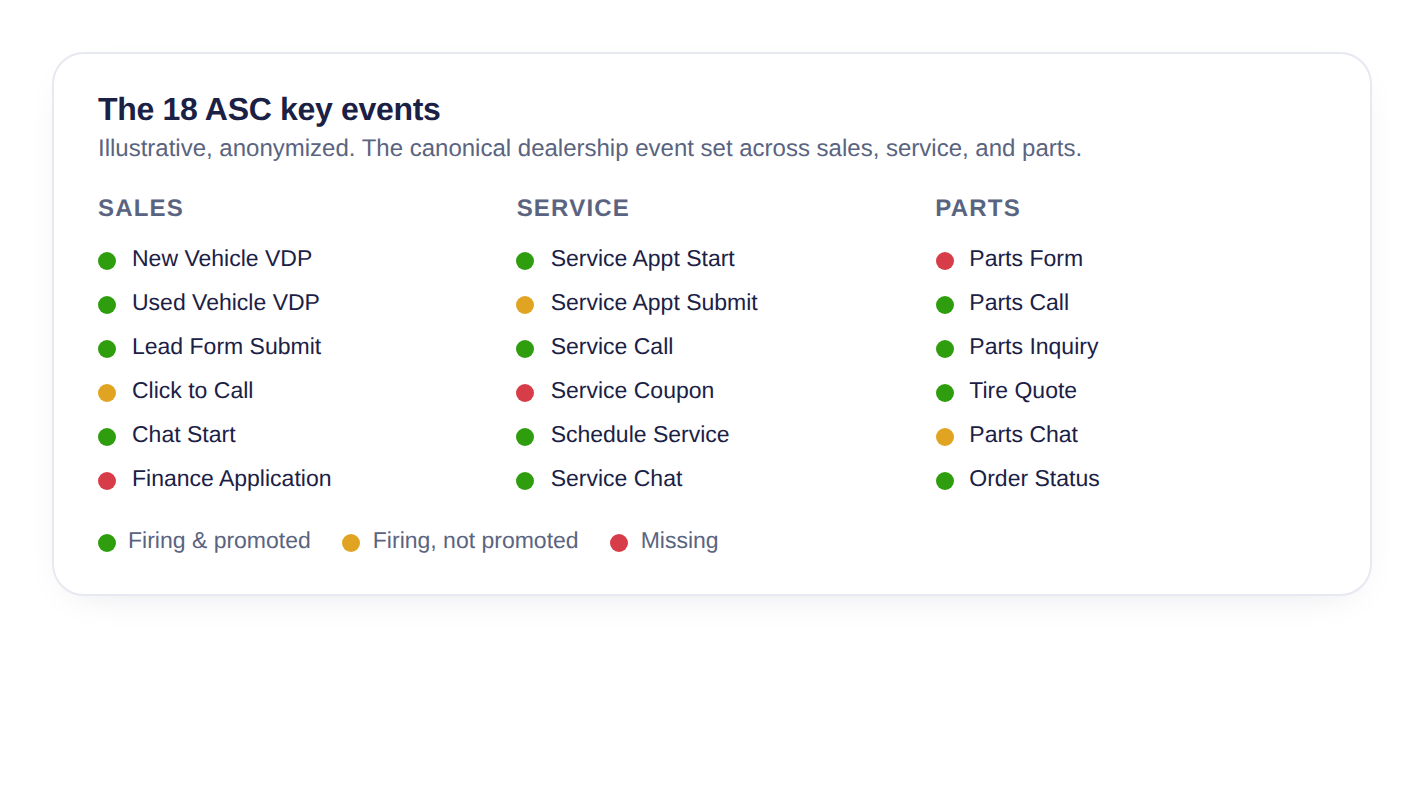
There is a published answer to "what should a dealership actually track." The ASC specification defines 18 canonical events across sales, service, parts, and appointments. One name, one definition, applied the same way at every store. Dealer Insights helped create that standard, so I will be blunt about why it exists. Before it, every vendor counted its own way. One called a form start a "lead conversion." One counted a 3-second phone tap as a call. One double-counted chat. Comparing two vendors was comparing two invented scorecards. The ASC standard kills the spin: a lead conversion means the same event whether your SEO company, your paid company, or your website provider is reporting it. That is the whole point of a standard. Not that 18 is a magic number. That everyone is finally measured against the same 18.
The three ways it breaks
In an audit, GA4 misconfiguration almost always shows up as one of three failure modes. Critical events missing. The event was never built. Service scheduler starts do not fire. Parts form submissions are invisible. Click-to-call is tracked on the sales number but not the service line. The activity is happening on your site every day. GA4 simply has no record of it, so neither do your reports. Events firing but never promoted. This one is sneaky. The event exists in GA4. It fires correctly. But nobody flipped the switch to make it a key event. That means it is invisible to your key-event reporting and, more importantly, invisible to smart bidding. Google is optimizing your campaigns without ever seeing the conversion you care most about. Rogue key events inflating the count. The opposite problem. Someone marked "page_view" or "scroll" or a menu click as a key event years ago. Now your conversion total is padded with actions that mean nothing. The number looks strong. It is mostly air. And once smart bidding starts chasing that air, it buys you more of the wrong thing. None of these require a villain. A tag got renamed. A site migration dropped a trigger. A default template shipped with three junk key events turned on. Neglect and accident, not malice. But the report lies either way.
What breaks downstream
Here is why this is not a technical footnote. Smart bidding optimizes to the wrong signal. Google Ads bids toward whatever you defined as valuable. Feed it a rogue key event and it will faithfully hunt down more of that useless action, at scale, with your budget. Reports overstate or understate. Missing events make a strong channel look dead. Rogue events make a weak channel look like a hero. Either way, the story you are being told does not match what your customers actually did. Vendor comparisons become meaningless. If Vendor A counts qualified calls and Vendor B counts every phone tap, Vendor B "wins" every month while doing less. Without a shared standard, you cannot referee the fight. You are just picking whoever reports the biggest number.
The check: 18 events, one table
Here is the standard, laid out so you can walk your own GA4 against it. Event names below follow the ASC convention; your setup may use slightly different labels, which is itself worth noting.
| # | Event | Department | What it captures |
|---|---|---|---|
| 1 | asc_vehicle_detail_view | Sales | VDP view on a specific vehicle |
| 2 | asc_inventory_search | Sales | Search or filter of inventory |
| 3 | asc_retail_process_start | Sales | Lead conversion or checkout flow started |
| 4 | asc_form_submission | Sales | Sales lead conversion (form) |
| 5 | asc_click_to_call | Sales | Sales phone number tapped |
| 6 | asc_phone_call_qualified | Sales | Qualified call, 60s or longer |
| 7 | asc_trade_in_submit | Sales | Trade-in valuation submitted |
| 8 | asc_test_drive_request | Sales | Test drive requested |
| 9 | asc_finance_application | Sales | Credit or finance app started |
| 10 | asc_service_scheduler_start | Service | Service scheduler opened |
| 11 | asc_service_appointment_submit | Service | Service appointment booked |
| 12 | asc_service_click_to_call | Service | Service line tapped |
| 13 | asc_service_call_qualified | Service | Qualified service call, 60s+ |
| 14 | asc_parts_form_submission | Parts | Parts inquiry submitted |
| 15 | asc_parts_click_to_call | Parts | Parts line tapped |
| 16 | asc_offer_engagement | Appointments | Coupon or offer viewed or printed |
| 17 | asc_directions_click | Appointments | Get-directions or map click |
| 18 | asc_chat_engagement | Appointments | Chat conversation started |
The numbers you will see attached to these in your own account are yours. The events themselves are the standard.
DIY: check it yourself
You can do a rough version of this in ten minutes. In GA4, open Admin. Look at two lists: Events and Key events. Walk both against the table above. Two questions:
- What is on the 18-event list but missing from your Events list? Those are the blind spots.
- What is marked as a key event that is not on the 18? Those are the rogue events, quietly inflating your totals and steering your bidding.
Write down every mismatch. That list is not the answer, but it is the exact set of questions to take to your agency: "Why isn't service scheduler tracked? Why is page_view a key event? Which of these is smart bidding using?" Make them explain the configuration. Do not accept "the numbers look fine."
Where this fits in an audit
GA4 configuration scoring is a standard section of every audit we run, because everything else depends on it. There is no point grading a channel's performance if the events feeding that grade are broken. We check all 18, plus the rogue events inflating your numbers, in the free audit. You get the mismatch list, the questions to hand your agency, and a straight answer on whether your reports are built on data or on sand.