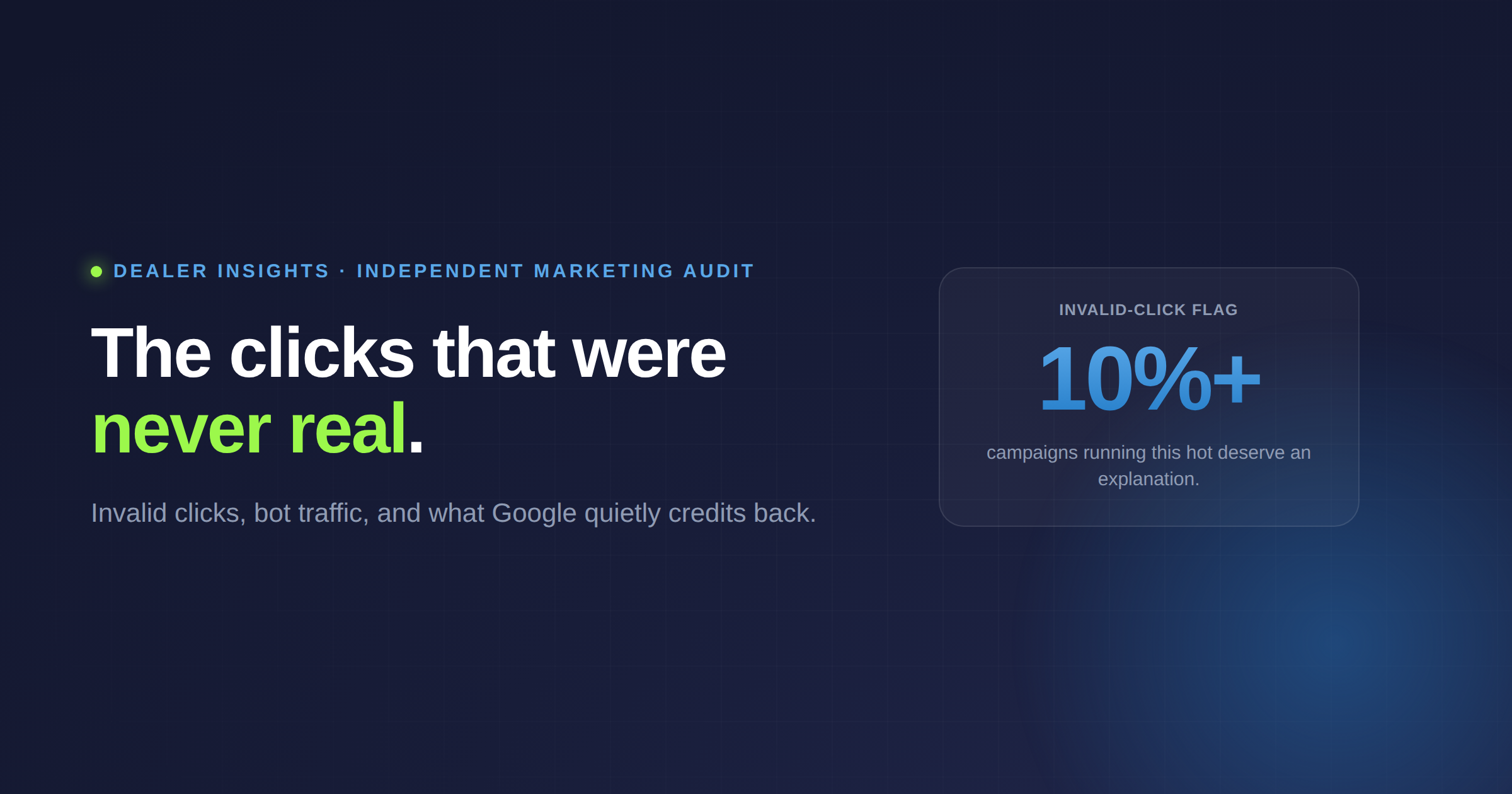
Some of the clicks you paid for were never people. Google knows. Do you? Every account has a slice of traffic that was never human. Bots crawling the web. A thumb that grazed an ad twice on a phone. The same visitor hitting the same ad five times in a minute. Google detects some of it, quietly credits it back, and moves on. The number is sitting in your account right now. Most dealers have never looked at it.
What invalid clicks actually are
Invalid clicks are the clicks Google decides did not come from a real person with real intent. The plain-English taxonomy breaks down into a few buckets.
Bots and automated traffic. Crawlers, scripts, and scrapers move across the web all day. Some of them hit ads. That is machine traffic, not a shopper.
Accidental taps. Mobile ads sit close to content. A scroll turns into a tap. The person never meant to click and bounces in under a second.
Repeated or duplicated clicks. One user clicking the same ad over and over in a short window. Sometimes curiosity, sometimes a rough connection reloading, sometimes something more deliberate.
Click farms and coordinated activity. Organized clicking, human or automated, with no buying intent behind it. Rarer, but it exists.
None of this means someone is out to get your dealership. It is the background noise of running ads on the open internet. The question is not whether it happens. It happens to everyone. The question is how much, and whether anyone on your side has checked.
What Google does about it
Google filters a portion of this automatically. Its systems look at click patterns before you ever get charged, flag what looks invalid, and remove those clicks from your billing. When the filtering happens after the fact, you get a credit. That credit shows up as an adjustment in your account, and the invalid clicks get logged in their own columns so you can see them. Here is the honest caveat. Detection is imperfect in both directions. Google catches a lot, but not everything, so some invalid traffic still slips through and gets billed as real. It also occasionally flags legitimate clicks as invalid, which means the odd real shopper gets filtered out. No system reading billions of clicks lands on perfect. That is fine. The point is that Google publishes its own count of what it caught, and that count is a signal worth reading. Think of it this way: the invalid-click number is Google grading its own detection out loud. You get to see the score.
Reading your invalid rate
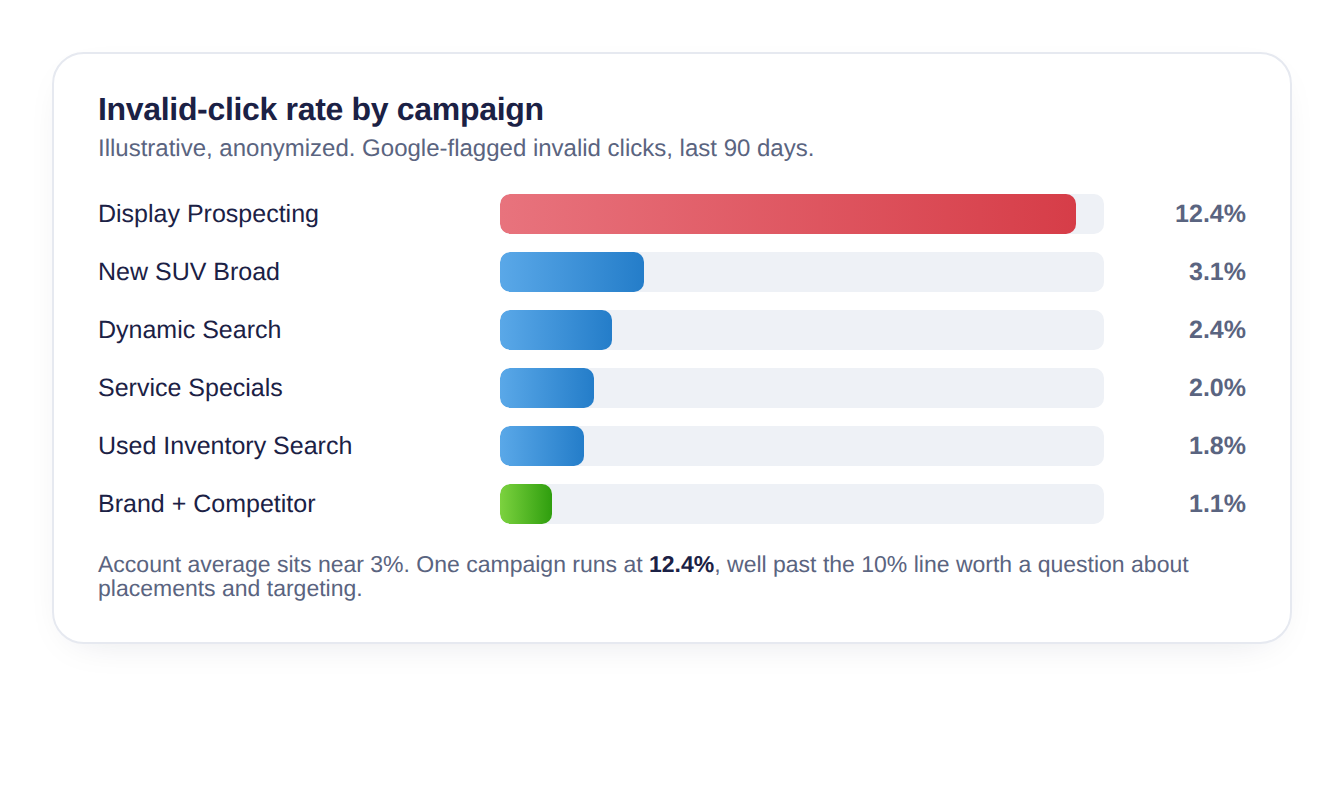
The data lives in Google Ads. At the campaign level you can add two columns: Invalid Clicks and Invalid Click Rate. Set the window to the last 90 days so one odd week does not skew the picture. What does normal look like? A low single-digit percentage is ordinary. Plenty of healthy accounts sit in the low-to-mid single digits and that is just the cost of being online. The number that deserves attention is 10 percent and up. A campaign running that hot is not automatically broken, but it is unexplained, and unexplained is the thing you fix. Someone should be able to tell you why that campaign attracts more invalid traffic than the rest of the account. To be clear about what these figures represent: the examples below are illustrative and anonymized, not pulled from a specific dealer's account. They show the shape of the problem, not one store's receipts.
Campaign-level hot spots
The account-wide number can look calm while one campaign runs hot underneath it. This is where the campaign view earns its keep. Take an illustrative, anonymized example. An account averages around 4 percent invalid clicks across everything. Fine. But one Display campaign is sitting at 18 percent on its own. Blended into the account total, that spike barely moves the average. Looked at alone, it is glaring. An outlier like that raises questions, not accusations. Where are those ads actually showing? Display and partner networks place ads across a huge spread of sites and apps, and some of those placements pull far more junk traffic than others. Is the targeting too broad? Is the campaign running on placements nobody has reviewed in a year? Junk traffic like this tends to concentrate in a few spots, not spread evenly, so the campaign-level read is where you find it. You are not looking to blame anyone. Configurations drift. Defaults get left on. A placement list nobody has opened since setup quietly fills with low-quality inventory. The finding is the number and the fact that it went unexamined, not a villain. Here are the questions worth handing your agency: Which placements is this campaign running on? When were they last reviewed? What is the invalid traffic rate on our highest-spend campaigns, and why is this one so far above the rest?
The shielded dollars
Add up the credits Google issued for invalid clicks over a stretch of time and you get a specific figure: the amount the system itself already admitted was not real traffic. That is not a projection or an estimate on your part. It is Google's own accounting of clicks it decided you should not pay for. That framing matters because it is fact, not argument. You are not claiming anything was stolen. You are reading back what the platform already conceded. And it points straight at the follow-up question: if the system caught this much, what is the rate on the campaigns it did not fully filter, and has anyone looked?
DIY: check it yourself
Open Google Ads and go to the campaign view. Add two columns: Invalid Clicks and Invalid Click Rate. Set the date range to the last 90 days. Sort by Invalid Click Rate, highest first. Anything sitting at 10 percent or more goes on your question list. That is the whole exercise. Ten minutes, no tools, no consultant. You will either confirm your account is clean or find a campaign nobody has explained to you.
Where the audit fits
Invalid-click analysis with campaign outliers is a standard section in every Dealer Insights audit. We pull the invalid traffic rate across the account, flag the campaigns running hot, and hand you the questions to take to whoever manages your spend. We do not run your ads. We keep score, across every vendor, using your real numbers. Your invalid-click number exists right now inside your account. The free audit reads it for you and flags the campaigns running hot. Get your free audit.